
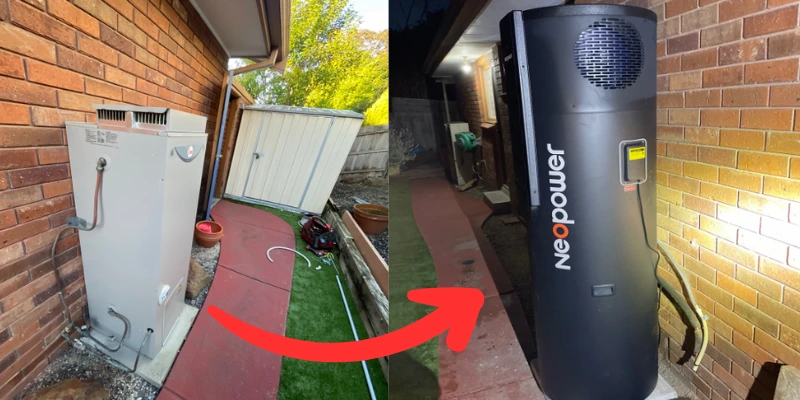
A Melbourne homeowner in Werribee upgraded their old gas hot water system for a 320L Neopower heat pump. Thanks to $1,234 in government rebates, they only paid $2,450 out of pocket. If they’d replaced it with another gas system instead, they wouldn’t have gotten any rebate at all — gas systems don’t qualify. This guide breaks down the real differences between the two technologies using actual 2026 numbers, not gas company marketing, so you can make an informed decision.
Gas Hot Water vs Heat Pump: Side-by-Side Comparison
| Factor | Gas Hot Water | Heat Pump (Electric) |
|---|---|---|
| Victorian government rebate | None | Up to $1,234 (STCs + VEECs) |
| VEU program eligible | No | Yes — VEU Approved models qualify |
| Running cost efficiency | 1:1 energy conversion (~80–90%) | 3–4× more efficient (COP 3–4) |
| Pairs with rooftop solar | No | Yes — run on solar generation |
| Gas supply dependency | Ongoing gas connection required | Gas connection not required |
| Victorian compliance trend | New gas appliances phasing out in VIC | Aligned with Victorian electrification policy |
Why Victorian Rebates Favour Heat Pumps
Neither the federal STC scheme nor Victoria’s VEU program provides rebates when you replace one gas hot water system with another. Both programs specifically support the replacement of gas appliances with high-efficiency electric alternatives. On the Werribee 320L Neopower installation, the homeowner received 18 STCs at $38 each ($684) under the federal scheme plus $550 in VEECs under the VEU program — a combined $1,234 applied as a price reduction with zero government paperwork required from the homeowner.
If you replace a broken gas hot water system with another gas unit, you receive nothing. If you upgrade to a VEU-eligible heat pump through a VEU Approved provider, you receive both rebates automatically.
Running Costs: The Long-Term Difference
Heat pumps use ambient air to heat water rather than burning gas directly. A typical heat pump operates at a Coefficient of Performance (COP) of 3–4, meaning it produces 3–4 units of heat energy for every 1 unit of electricity consumed. A gas hot water system converts approximately 80–90% of the gas burned into useful heat — it cannot exceed 1:1. For Melbourne homeowners with rooftop solar already installed, running the heat pump during daytime generation hours can reduce the effective operating cost further, since you’re heating water from your own generation rather than the grid.
What About Installation Complexity?
Switching from gas hot water to a heat pump involves more than a tank swap. The old gas unit must be safely decommissioned — the gas line capped, the tank permanently rendered inoperable, and the unit removed and recycled. Electrical connections are required for the new heat pump. GES coordinates all trades — electrical, plumbing, and gasfitting — as part of the complete upgrade. On the Werribee 320L heat pump installation, all of this was included in the single all-in price of $3,684 before rebates, reducing to $2,450 after the $1,234 government rebate.
Heat Pump Installation in Melbourne – Frequently Asked Questions
Is a heat pump hot water system better than gas in Melbourne in 2026?
For most Melbourne homeowners replacing an existing gas system, a heat pump offers three advantages gas cannot match: up to $1,234 in government rebates (18 STCs at $38 = $684 plus $550 VEECs on a documented 2026 install), 3–4× greater running efficiency (COP 3–4 vs gas at under 1:1), and compatibility with rooftop solar. Gas replacements attract no VEU or STC rebate.
Can I still install a gas hot water system in Victoria in 2026?
Existing gas hot water systems can be replaced on a like-for-like basis in most Victorian properties in 2026, but replacement gas systems attract no government rebates. Victoria’s electrification policy increasingly supports switching away from gas appliances, and the VEU and STC programs provide financial incentives only for electric upgrades such as heat pumps.
How much cheaper is a heat pump to run than gas hot water in Melbourne?
Heat pumps typically operate at COP 3–4, producing 3–4 units of heat per unit of electricity. Gas systems convert roughly 80–90% of fuel to heat. Actual savings depend on your electricity tariff, gas price, and usage patterns. Homeowners with existing rooftop solar can reduce operating costs further by scheduling heat pump operation during solar generation hours.
Do I need to decommission my gas system when switching to a heat pump?
Yes. A gas-to-heat-pump upgrade requires professional decommissioning of the old gas unit — the gas line must be capped, the tank permanently rendered inoperable (typically by drilling), and the old unit removed and recycled. GES includes gas decommissioning as part of the complete upgrade, coordinating all electrical, plumbing, and gasfitting trades in a single project.
Is Green Electric Solutions a VEU Approved provider for heat pump hot water?
Yes. GES is a VEU Approved provider, which is the accreditation required to apply Victorian VEU VEEC rebates directly to your heat pump installation cost. GES also manages federal STC creation and trading. Both rebates are applied as a direct price reduction with no government paperwork from the homeowner.
Contact Us
Recent Hot Water Upgrades Across Victoria
- Werribee 320L Heat Pump Hot Water Upgrade | $1,234 VEU & STC Rebates | Green Electric Solutions
- 320L NeoPower Heat Pump Hot Water Upgrade in Hillside VIC | $1234 Govt. Rebates
- 320L NeoPower Heat Pump Installation in Roxburgh Park
- Point Cook Homeowner Saved $2,134 on a 320L Heat Pump
- Mickleham Homeowner Saved $1,684 with a 320L Heat Pump Upgrade
- 320L Hot Water Heat Pump Installation in Point Cook for only $2,350
- 320L Heat Pump Upgrade in Broadmeadows – $2,100 VEU Rebate Availed
- 280L Midea Heat Pump Hot Water Upgrade In Doreen | 2,196 VEU Rebate